C06 | Biofabrication strategies for modelling kidney compartments and diseases
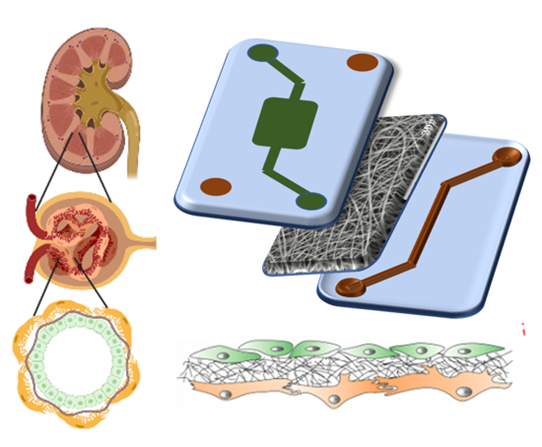
Our research aims to develop advanced, lab-grown kidney models to better study how the kidney works and why kidney diseases occur – while reducing the need for animal experiments. The kidney contains two key structures: the glomerulus, which filters the blood, and the tubules, which fine-tune the composition of urine. Traditional 2D cell cultures are far too simple to mimic these complex structures, so we are creating bioengineered systems that more closely resemble the real organ. In the first phase of the project, we developed a dynamic model of the glomerular filtration barrier (GFB). Using extremely fine electrospun fibers, we created a scaffold on which glomerular endothelial cells and podocytes can grow. In a custom bioreactor, this system reproduced important natural features, such as fenestrated endothelial cells, cell–cell communication, and realistic filtration properties. Building on this work, we now aim to make our kidney models even more complex by integrating patient-derived cells and kidney organoids. We are also developing a proximal tubule model using cutting-edge 3D printing and biofabrication techniques to create tiny, functional channels lined with kidney cells. This model will be used to study processes such as inflammation, fibrosis, and drug effects. In addition, we will combine kidney organoids with engineered vascular structures, enabling the formation of functional microvessels that support organoid maturation. All constructs will be cultured in dynamic bioreactors to more closely mimic the physical environment of the kidney. Our goal is to create patient-specific kidney models that improve disease research, enable better drug testing, and help reduce reliance on animal studies.